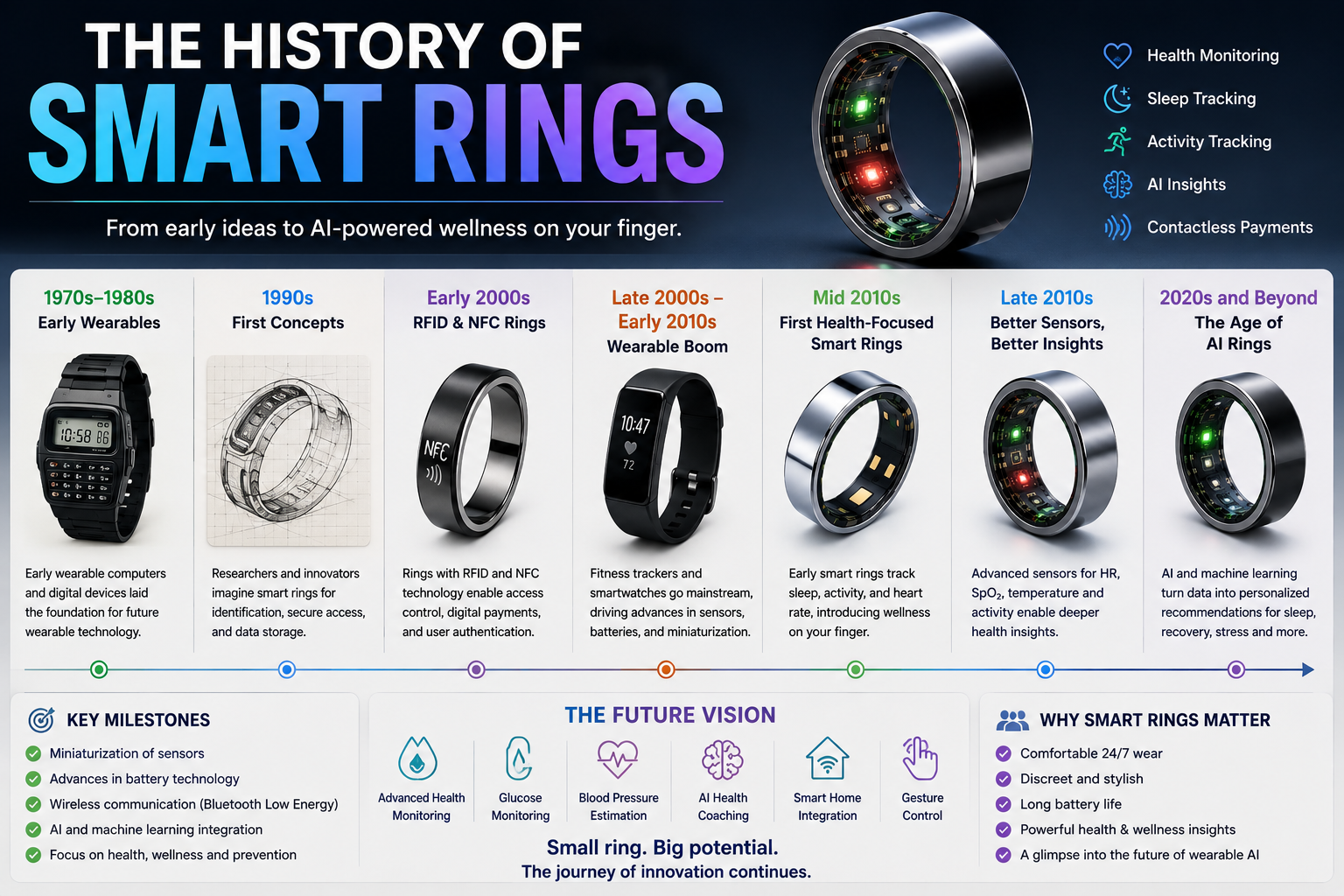
Smart rings may seem like a recent innovation, but their history stretches back several decades. What began as experimental wearable technology has evolved into a rapidly growing category of devices capable of monitoring health, tracking fitness, enabling contactless payments, and delivering AI-powered insights.
Today’s smart rings combine advanced sensors, wireless communication, and artificial intelligence in a device small enough to fit on a finger. However, the journey to modern AI Rings involved years of technological advancements, miniaturization, and innovation in wearable computing.
In this article, we’ll explore the history of smart rings, from early concepts to the sophisticated AI-powered devices available today.
The Origins of Wearable Technology
Before smart rings existed, wearable technology primarily focused on watches, calculators, and early computing devices.
During the 1970s and 1980s, researchers began experimenting with wearable electronics that could provide information without requiring users to carry larger devices. These early systems were bulky and often designed for military, industrial, or academic purposes.
As microprocessors became smaller and more powerful, engineers started exploring ways to embed computing capabilities into everyday objects, including jewelry.
The idea of a connected ring emerged from this broader vision of wearable computing.
Early Smart Ring Concepts
The first smart ring concepts appeared during the 1990s.
Researchers and technology companies imagined rings that could:
- Store digital information
- Act as identification devices
- Unlock secure systems
- Communicate wirelessly
- Control electronic equipment
At the time, battery technology and miniaturized sensors were not advanced enough to support the health-monitoring capabilities we see today.
Most early designs focused on simple data storage and access control rather than fitness or wellness tracking.
The Rise of RFID and NFC Rings
One of the earliest practical uses of smart rings involved RFID (Radio Frequency Identification) and NFC (Near Field Communication) technology.
During the early 2000s, several companies developed rings capable of:
- Opening doors
- Authenticating users
- Making secure payments
- Storing digital credentials
These rings did not contain advanced sensors or artificial intelligence, but they demonstrated that wearable devices could provide convenient access to digital services.
Many modern payment-enabled rings still use NFC technology as a core feature.
The Wearable Technology Boom
The launch of wearable fitness devices in the late 2000s and early 2010s changed the technology landscape.
Products such as fitness trackers and smartwatches introduced consumers to:
- Step counting
- Heart rate monitoring
- Activity tracking
- Sleep monitoring
As these technologies matured, manufacturers began exploring smaller form factors.
The finger became an attractive location for health monitoring because it provides strong physiological signals, particularly for heart rate and blood flow measurements.
This realization helped accelerate smart ring development.
The First Generation of Health-Focused Smart Rings
The mid-2010s marked a major turning point for smart rings.
Advances in sensor miniaturization, battery efficiency, and wireless communication made it possible to create rings capable of collecting meaningful health data.
Early health-focused smart rings introduced features such as:
- Sleep tracking
- Activity monitoring
- Heart rate measurement
- Wellness scoring
Although these devices were more limited than today’s models, they demonstrated the potential of finger-based wearable technology.
Many consumers appreciated the ability to track health without wearing a smartwatch.
Improvements in Sensor Technology
Throughout the late 2010s, smart ring technology improved significantly.
Manufacturers began integrating:
Optical Heart Rate Sensors
These sensors use light to measure blood flow and calculate heart rate.
Accelerometers
Motion sensors allowed rings to track movement and activity.
Temperature Sensors
Temperature monitoring added valuable wellness and recovery insights.
Blood Oxygen Sensors
Some devices expanded into oxygen saturation monitoring.
The combination of these sensors enabled more accurate health and sleep tracking.
The Introduction of Artificial Intelligence
One of the most important milestones in smart ring history was the integration of artificial intelligence.
Traditional fitness trackers collected data, but AI-enabled rings began interpreting that data.
Artificial intelligence allowed smart rings to:
- Detect patterns
- Learn user behavior
- Generate recommendations
- Predict recovery needs
- Identify wellness trends
Rather than simply displaying numbers, AI systems started helping users understand what the data actually meant.
This shift transformed smart rings from tracking devices into intelligent wellness tools.
Smart Rings During the Health and Wellness Revolution
The global focus on health and wellness during the late 2010s and early 2020s significantly increased interest in wearable technology.
Consumers became more interested in:
- Sleep optimization
- Stress management
- Recovery tracking
- Preventive health monitoring
Smart rings were well-positioned to meet these needs.
Their advantages included:
- Comfortable overnight wear
- Continuous monitoring
- Long battery life
- Discreet design
As awareness grew, smart rings became increasingly popular among athletes, professionals, and health-conscious consumers.
The Emergence of AI Rings
Modern AI Rings represent the latest stage in the evolution of smart ring technology.
Today’s devices combine:
- Advanced sensors
- Machine learning
- Cloud computing
- Personalized analytics
- Mobile app ecosystems
AI Rings can now provide insights into:
- Sleep quality
- Recovery readiness
- Activity patterns
- Stress levels
- Long-term wellness trends
Many devices generate daily readiness scores and personalized recommendations based on individual health data.
The emphasis has shifted from simply collecting information to helping users make better decisions.
Smart Rings vs Smartwatches
As smart rings evolved, they began competing with smartwatches and fitness trackers.
While smartwatches offer:
- Large displays
- Notifications
- Apps
- GPS functionality
Smart rings focus on:
- Comfort
- Passive monitoring
- Sleep tracking
- Recovery insights
- Long battery life
Rather than replacing smartwatches, smart rings often complement them by providing continuous health monitoring in a less intrusive form factor.
Current Smart Ring Technology
Today’s smart rings are among the most sophisticated wearable devices available.
Modern features may include:
- Heart rate monitoring
- Heart rate variability tracking
- Sleep analysis
- Stress detection
- Recovery scoring
- Temperature monitoring
- Blood oxygen measurement
- Contactless payments
- AI-generated recommendations
What once required bulky wearable devices can now be accomplished by a ring weighing only a few grams.
The Future of Smart Rings
The history of smart rings is still being written.
Future developments may include:
Advanced Health Monitoring
Researchers continue exploring new biometric measurements and health indicators.
Continuous Glucose Monitoring
Non-invasive glucose tracking remains one of the industry’s most anticipated innovations.
Blood Pressure Estimation
Improved sensors and AI models may enable more accurate blood pressure monitoring.
AI Health Coaching
Future smart rings may act as personal wellness assistants capable of delivering highly personalized guidance.
Smart Home Integration
Gesture controls and connected ecosystems could expand the role of smart rings beyond health tracking.
Ambient Computing
Smart rings may become key devices in a future where technology operates seamlessly in the background.
Why Smart Rings Matter
The evolution of smart rings reflects a broader trend in technology.
Consumers increasingly want devices that are:
- Smaller
- Smarter
- More comfortable
- Less distracting
- More personalized
Smart rings embody these goals by delivering sophisticated functionality without requiring constant interaction.
As artificial intelligence and sensor technology continue to advance, smart rings are likely to become even more capable and more deeply integrated into everyday life.
Final Thoughts
The history of smart rings is a story of continuous innovation. From early concepts focused on digital identification to today’s AI-powered health companions, smart rings have evolved dramatically over the past few decades.
Advances in sensors, wireless communication, battery technology, and artificial intelligence have transformed these small devices into powerful tools for health, wellness, and personal insight. As technology continues to improve, smart rings are poised to play an increasingly important role in the future of wearable computing, offering a glimpse into a world where intelligent technology is always available—yet almost invisible.