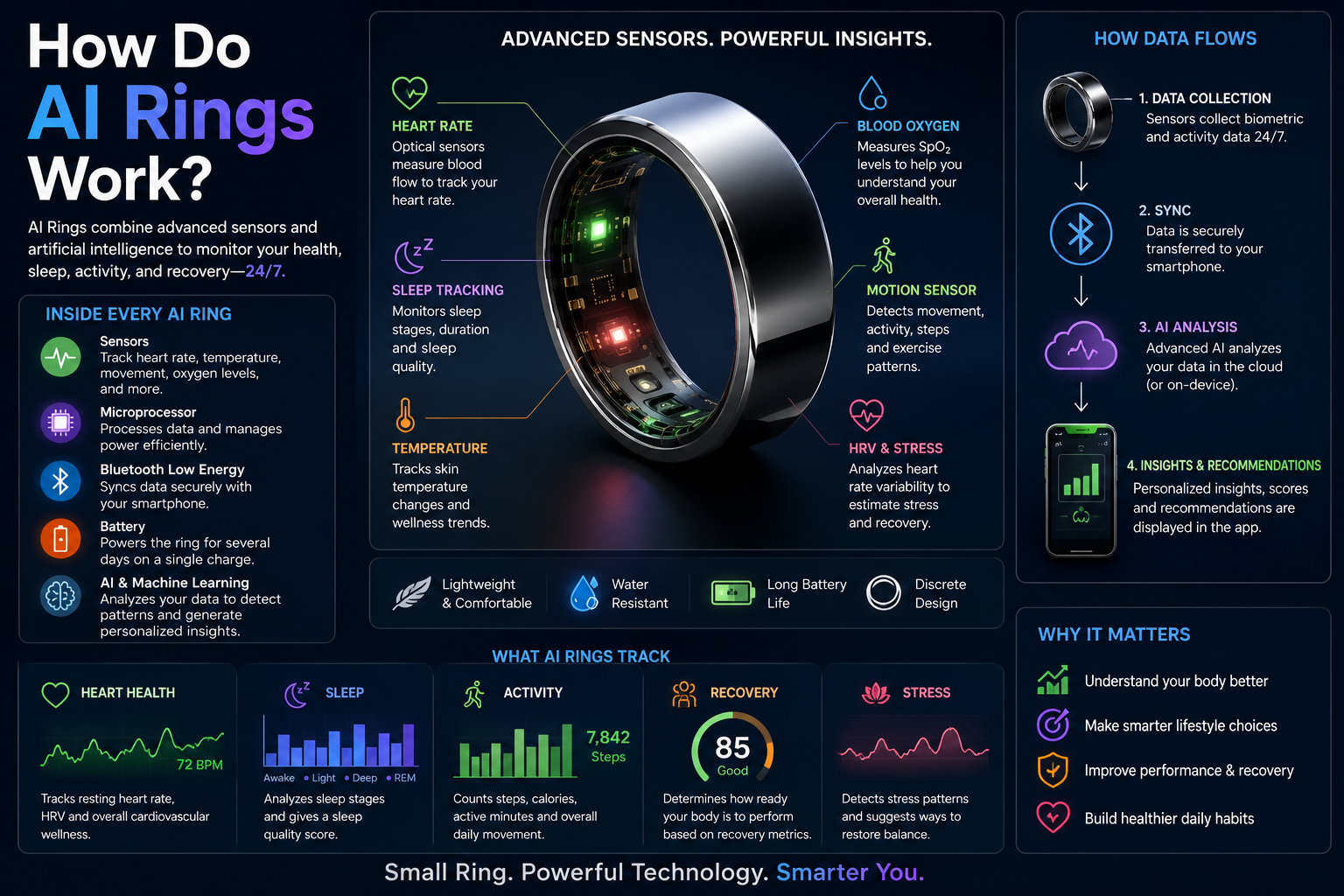
AI Rings are among the most advanced wearable devices available today. Despite their small size, these smart rings contain sophisticated sensors, miniature processors, wireless communication technology, and artificial intelligence systems capable of monitoring health, sleep, activity, and wellness around the clock.
What makes AI Rings particularly impressive is their ability to transform raw biometric data into personalized insights that help users improve their health, recovery, fitness, and daily habits. But how exactly do these tiny devices accomplish so much?
In this guide, we’ll explore how AI Rings work, the technology inside them, and how artificial intelligence turns sensor readings into meaningful recommendations.
What Is an AI Ring?
An AI Ring is a wearable smart device worn on a finger that uses sensors and machine learning algorithms to collect and analyze health and activity data.
Unlike traditional fitness trackers that primarily display metrics, AI Rings focus on interpreting data and providing actionable insights. They continuously monitor the wearer and use artificial intelligence to identify patterns, trends, and changes in health and behavior.
Most AI Rings connect to a smartphone app where users can view detailed reports and personalized recommendations.
The Core Components Inside an AI Ring
Although they appear simple from the outside, AI Rings contain several advanced technologies packed into a very small space.
Sensors
Sensors are the foundation of every AI Ring. These components collect information about your body and movements.
Microprocessor
A miniature processor handles data collection and basic computations before transmitting information to a companion app.
Battery
Rechargeable batteries power the ring for several days between charges.
Wireless Connectivity
Most AI Rings use Bluetooth technology to sync data with smartphones and cloud services.
Artificial Intelligence Software
AI systems analyze collected data to generate insights and recommendations.
Together, these components create a wearable device capable of continuously monitoring wellness metrics.
How AI Rings Measure Heart Rate
One of the most important functions of an AI Ring is heart rate monitoring.
Most rings use a technology called photoplethysmography (PPG).
Here’s how it works:
- Tiny LED lights shine into the skin.
- Blood absorbs light differently than surrounding tissue.
- Sensors detect changes in reflected light.
- Algorithms calculate heart rate from blood flow patterns.
Because fingers contain many blood vessels, AI Rings often achieve highly accurate heart rate measurements.
Heart rate data can be collected during:
- Rest
- Exercise
- Sleep
- Recovery periods
- Daily activities
This information helps AI systems understand overall cardiovascular health and activity levels.
How AI Rings Track Sleep
Sleep tracking is one of the most popular uses of AI Rings.
The ring continuously monitors:
- Heart rate
- Heart rate variability (HRV)
- Movement
- Body temperature
- Breathing patterns
AI algorithms combine these signals to estimate:
Light Sleep
The transitional phase between wakefulness and deeper sleep.
Deep Sleep
The restorative stage associated with physical recovery.
REM Sleep
The sleep stage most closely linked to dreaming and cognitive recovery.
Sleep Duration
The total amount of time spent sleeping.
Sleep Efficiency
The percentage of time in bed actually spent asleep.
The AI then converts these measurements into sleep scores and recommendations.
How AI Rings Monitor Activity
AI Rings include motion sensors called accelerometers and gyroscopes.
These sensors detect:
- Walking
- Running
- Cycling
- General movement
- Exercise intensity
The ring measures:
- Steps taken
- Distance estimates
- Calories burned
- Active minutes
- Sedentary time
Machine learning algorithms help distinguish between different types of movement and activities.
As a result, the ring can provide a more complete picture of daily activity levels.
How AI Rings Measure Recovery
Recovery tracking has become one of the most valuable features of modern AI Rings.
Recovery refers to how prepared your body is for physical and mental demands.
AI Rings analyze:
- Resting heart rate
- Heart rate variability
- Sleep quality
- Body temperature trends
- Recent activity levels
Using these metrics, AI systems generate recovery scores that estimate whether your body is fully recovered or under strain.
For athletes and active individuals, these insights can help optimize training and prevent overexertion.
How AI Rings Detect Stress
Many AI Rings estimate stress levels using physiological indicators.
The AI looks for patterns in:
- Heart rate variability
- Elevated heart rate
- Sleep disruptions
- Activity patterns
When certain patterns appear, the system may identify periods of elevated stress.
Some AI Rings also provide recommendations such as:
- Relaxation exercises
- Breathing sessions
- Rest periods
- Sleep improvements
The goal is to help users recognize stress before it negatively affects health and performance.
The Role of Artificial Intelligence
Artificial intelligence is what transforms a smart ring into an AI Ring.
Without AI, the device would simply collect data.
With AI, the system can:
Identify Patterns
AI detects trends that humans might overlook.
Learn User Behavior
Machine learning models adapt to individual habits and routines.
Generate Recommendations
Instead of presenting raw numbers, AI offers actionable guidance.
Detect Anomalies
The system can identify unusual changes in sleep, activity, heart rate, or recovery.
Improve Over Time
As more data is collected, recommendations become increasingly personalized.
This personalization is one of the biggest advantages of AI-powered wearables.
Cloud Processing vs On-Device AI
AI Rings typically use one of two processing methods.
On-Device Processing
Some calculations occur directly on the ring.
Benefits include:
- Faster responses
- Better privacy
- Reduced cloud dependency
Cloud-Based Processing
Many advanced analyses are performed in the cloud.
Benefits include:
- More computing power
- More sophisticated AI models
- Continuous software improvements
Most modern AI Rings use a combination of both approaches.
How AI Rings Connect to Smartphones
AI Rings typically communicate using Bluetooth Low Energy (BLE).
The process works like this:
- The ring collects data.
- Data is stored temporarily on the device.
- Bluetooth transfers data to a smartphone.
- The companion app processes and displays information.
- Cloud servers may perform advanced analysis.
Users can then view:
- Daily activity reports
- Sleep summaries
- Recovery scores
- Health trends
- Personalized insights
All information is accessible through the mobile application.
Are AI Rings Accurate?
Modern AI Rings can be remarkably accurate for many wellness metrics.
They perform especially well for:
- Resting heart rate
- Sleep duration
- Heart rate variability
- Activity tracking
- Recovery monitoring
However, accuracy can vary depending on:
- Ring fit
- Sensor quality
- User movement
- Environmental conditions
- Individual physiology
While AI Rings provide valuable insights, they should not be considered replacements for professional medical equipment.
The Future of AI Ring Technology
AI Ring technology continues to evolve rapidly.
Future innovations may include:
- Continuous glucose monitoring
- Blood pressure tracking
- Advanced stress detection
- Predictive health alerts
- AI health coaching
- Emotion recognition
- Smart home integration
- Enhanced gesture controls
As artificial intelligence becomes more sophisticated, AI Rings may become powerful personal wellness assistants that continuously help users improve their health and lifestyle.
Final Thoughts
AI Rings work by combining advanced sensors, biometric monitoring, wireless connectivity, and artificial intelligence into a compact wearable device. They collect data about heart rate, sleep, activity, recovery, and wellness, then use machine learning algorithms to transform that information into personalized insights.
The result is a wearable that does far more than count steps. AI Rings help users understand their bodies, identify trends, improve habits, and make smarter decisions about health and wellness. As wearable technology continues to advance, AI Rings are likely to become an increasingly important part of everyday life.